
Nothing on this page is for sale, and there is no checkout waiting at the bottom. Every claim about hexarelin points to a study you can open yourself, mostly work indexed on PubMed and PMC. Last updated June 2026. Hexarelin has not been approved by the FDA as a drug for human use, and the human research on it is still thin. Read the evidence section before you decide anything.
Think about buying a used car from a stranger’s driveway versus buying one from a dealership with a warranty and a service history. The driveway car might have the exact same engine. It might even run fine for a while. But you’re buying it blind, and if something’s wrong under the hood, there’s nobody to call. The dealership car costs more up front. What you’re actually paying for is the part you can’t see: the inspection, the paper trail, the person who answers the phone if the transmission fails in month two.
That’s the whole story of buying hexarelin online, and it’s the lens I want to use for this whole piece. There are two ways to get it: through a supervised clinical channel where a licensed prescriber looks at your history first, or through a gray-market website selling “research use only” vials with no questions asked. The vial is cheaper per bottle. Almost everything else about it costs you more. Let’s walk through what hexarelin even is, how it behaves in your body, what actually separates these two buying paths, and how to think it through for yourself.
What hexarelin actually is
Start simple. Hexarelin is a small, lab-made chain of six amino acids called a peptide. Its job is to knock on the door of a receptor in your pituitary gland (the pea-sized gland at the base of your brain) called GHSR-1a, the same receptor your body’s own hunger hormone, ghrelin, uses. When hexarelin knocks, your pituitary releases a pulse of growth hormone. That’s why it gets grouped with a family of compounds called GHRPs (growth hormone releasing peptides) and marketed for recovery, body composition, and anti-aging.
The pulse is quick. Growth hormone levels peak roughly half an hour after an injection, and hexarelin itself clears from the blood with a half-life around an hour. So far, that’s a fairly ordinary secretagogue story.
Here’s the part that makes hexarelin different from its cousins: it also binds to a receptor called CD36, which sits in heart tissue, through a pathway that has nothing to do with growth hormone at all. A 2002 study in Circulation Research identified CD36 as the receptor responsible for the cardiovascular effects of this whole peptide family, showing dose-dependent changes in coronary blood flow that disappeared entirely in animals bred without the CD36 receptor [P1]. That’s a real, distinct mechanism, and it’s the reason hexarelin gets studied for heart-related questions that most GH peptides never touch.
How it works, and where the evidence actually stands
Animal studies have chased that heart angle for years. A 2017 study in the International Heart Journal found hexarelin protected rat heart cells from injury caused by blocked and restored blood flow, working through an interleukin-1 signaling pathway [P3]. A 2018 study in Physiological Reports found it preserved pumping function and cut down on scar tissue (fibrosis) in mice after a simulated heart attack [P5]. A 2014 review in the Journal of Geriatric Cardiology gathered this evidence and floated hexarelin as a possible future direction for certain cardiovascular conditions, while being careful to call it a research direction, not a treatment [P4].
Now, the honest caveat, and it’s an important one: animal data are the first rung on a very long ladder. They earn a compound the right to be tested in people. They are not the same as proof it works in people. The human cardiac evidence is genuinely small. The best piece of it is a 2002 trial in the European Journal of Pharmacology that gave hexarelin, as a single dose, to 24 men with coronary artery disease during bypass surgery, and found it quickly improved measures of heart performance, including ejection fraction and cardiac output, in a way that didn’t seem to be driven by growth hormone at all [P2]. That’s a real and interesting finding. It’s also one small study, done during surgery, on a specific population. It is nowhere near proof that hexarelin is a safe or effective long-term heart therapy. If you ever see a sales page quoting a dramatic mortality statistic, like a big drop in deaths after a heart attack, be skeptical: the verified mouse research talks about preserved function and reduced scarring, not a specific survival number [P5]. Open the study yourself before trusting a number like that.
There’s a second wrinkle worth knowing before you’d ever consider using it: hexarelin tends to wear out its welcome. Use it continuously and your body’s growth hormone response to it fades. A 1998 study in Growth Hormone & IGF Research found the response had dropped by week four and again by week sixteen of repeated dosing, though the drop was partial and came back after a break [P6]. A different 1996 study in the European Journal of Endocrinology found that short-term, intermittent dosing didn’t cause this fade-out at all [P7]. Put those two together and you get a practical rule: how you dose hexarelin, continuous versus cycled, decides whether it keeps doing anything. That’s not a detail you want to be guessing at alone.
Two ways to actually get it, and why the price tag is the wrong number to compare
So say someone decides they want to look into hexarelin. There are really only two roads in front of them.
Road one: a supervised clinical channel, where a licensed clinician reviews your medical history before anything is dispensed, and the product moves through a real pharmacy chain of custody.
Road two: a gray-market website selling it as a “research chemical,” where you add a vial to a cart, pay, and it shows up in the mail. Nobody looked at your heart. Nobody looked at your medications. Nobody is checking back in with you.
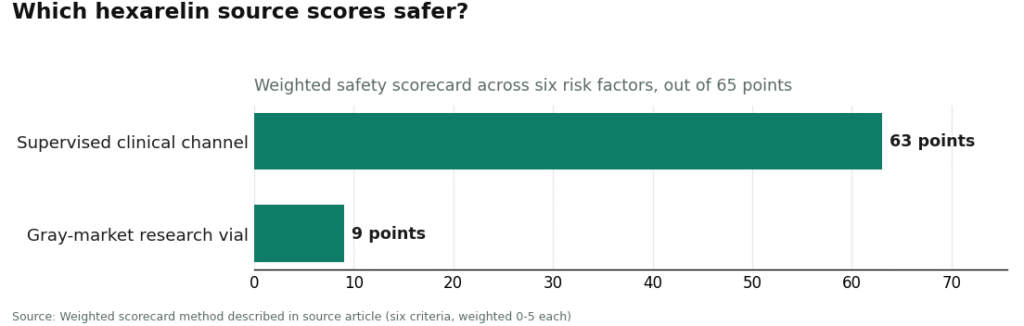
Go back to the used-car idea for a second. If you only compare the sticker price, the driveway car wins every time. But the sticker price was never measuring the thing that actually determines whether you get burned. To compare these two roads honestly, you have to score them on the things that actually change your risk, not just the number on the vial. So that’s what I did below: six factors, each weighted by how much it actually matters, scored zero to five for each road.
| What we’re grading (and how much it matters) | Supervised clinical channel | Gray-market research vial |
|---|---|---|
| A licensed clinician reviews you first (weighted x3) | 5 | 0 |
| Testing that an outside authority can actually enforce (weighted x3) | 5 | 1 |
| Honest about how thin the human evidence is (weighted x2) | 5 | 1 |
| Straight talk about legal and compounding status (weighted x2) | 5 | 1 |
| Real dosing and follow-up support (weighted x2) | 5 | 0 |
| Transparent about what you’re paying for (weighted x1) | 4 | 3 |
| Weighted total, out of 65 | 63 | 9 |
Sixty-three versus nine. That gap is not close, and it only flips in the vial’s favor on one narrow, unweighted point: the raw number on the sticker. Let’s go through why, one factor at a time.
Walking through the report card
A clinician looking at you first, before anything ships. This is weighted the heaviest for a reason: with hexarelin, having someone medically qualified evaluate you before you start is the single biggest lever for reducing risk, full stop. The gray-market vial scores a flat zero, and it’s not a cheap shot, it’s just accurate: you check a box, you pay, a package arrives. Nobody weighed your heart, your medications, or your hormone levels against a compound that’s genuinely doing several things at once (raising cortisol, sometimes more than its cousin GHRP-6 at similar doses, nudging prolactin upward, and acting directly on heart tissue through that CD36 pathway). A compound with that many moving parts is exactly the kind of thing you want a professional weighing against your specific situation, not something you want to self-administer based on a forum post. The supervised channel scores a 5 here, not because a clinician can promise hexarelin will help you (be wary of anyone who implies that), but because someone is actually accountable for the decision.
Testing that someone outside the seller can actually enforce. The vial doesn’t score zero here, and it’s worth being fair about that. Plenty of research-chemical sellers post a certificate of analysis, so it earns a 1. But a document is only worth something if somebody besides the company that wrote it can be held to it. A certificate posted on a seller’s own website might be accurate, or it might describe a different batch than the one that shipped to you, and there’s no way for you to know which, and nobody with the authority to recall the product if it’s wrong. The supervised channel scores a 5 because the product travels through a licensed pharmacy, inside a chain of custody where oversight and recall authority are actually built into the system, not just claimed on a label.
Honesty about how thin the evidence really is. This sounds like a soft, subjective category, but it’s a surprisingly reliable predictor of everything else a source will do to you. Gray-market pages tend to lean hard into potency claims, like calling hexarelin ten times more potent than your body’s own ghrelin, or “the strongest growth hormone releaser” in its class. A sharp hormone spike measured in a lab is not the same as a benefit you keep, and a page that only tells you what a compound can do, never what it can’t, earns its 1. The supervised channel earns a 5 for saying the plain thing out loud: the human cardiac data are sparse, most of the exciting findings are still in animals, and hexarelin isn’t FDA-approved for anything.
Straight talk about the legal gray zone. Hexarelin sits in an awkward spot, legally, and how honestly a source describes that spot tells you a lot. The vial scores a 1 because it usually leans on a “research use only” label, which isn’t actually a mark of quality. It’s the legal mechanism that lets a seller avoid being regulated as a drug supplier, and it only works because the product is, on paper, not meant for the human use everyone buying it clearly intends. A seller that hides behind that label while nudging you toward a dosing schedule is trying to have it both ways. The supervised channel scores a 5 for saying plainly that hexarelin isn’t FDA-approved and is harder to access through standard compounding channels than more established peptides, rather than burying that fact. There’s also an anti-doping wrinkle worth flagging here that the scorecard can’t fully price in for you individually: hexarelin is banned in competitive sport at all times under the World Anti-Doping Agency code, in the same growth-hormone-secretagogue class as its relatives. No “research use only” sticker changes that if you’re a tested athlete, so check the current WADA list yourself before going anywhere near this class of peptide.
Actual dosing guidance and follow-up. Remember that desensitization problem from earlier, where continuous use fades but cycled use may hold up better [P6][P7]? That’s a strategy question, and it’s exactly what a clinician and structured follow-up are built to help you work through. The vial gets another flat zero here, because the relationship ends the moment the package ships. A supervised channel scores a 5, in part because good follow-up actually depends on you keeping track of things too. People who log their dose, their cycle timing, and any symptoms as they go, for instance in a tracker app like the one FormBlends offers, show up to a check-in with real information instead of a vague memory of “I think I felt something in week two.” That kind of app is just a logging tool, not a prescription and not a shop.
Being upfront about what your money actually buys. This is the one category where the vial closes the gap, and it deserves a fair hearing. It earns a 3, not because it’s admirable, but because the number is genuinely transparent in the narrowest sense: you see a price, usually $40 to $80 a vial, and you pay it. What that number doesn’t tell you is anything about whether the vial’s contents are real or safe, which is most of what you’re actually buying. The supervised channel scores a 4, not a perfect 5, because clinical pricing has more moving parts and is harder to summarize in one line. Supervised hexarelin typically runs $90 to $200 a month, in the range of clinic-based care for this kind of peptide. That price isn’t really paying for the molecule, which is inexpensive. It’s paying for the clinician, the legitimate sourcing, and the accountability, which is the part actually protecting you. This is also the smallest gap on the whole scorecard, and not coincidentally, it’s the exact number that fools people, because it’s the easiest thing to compare and the least connected to your actual safety.
What to watch for
A few threads are worth pulling together before we get to the “how to decide” part.
First, hexarelin is genuinely doing more in your body than a simple growth-hormone bump. It touches cortisol, it touches prolactin, and it acts directly on heart tissue through a pathway unrelated to growth hormone. That’s not a reason to panic, but it is a reason this isn’t a “figure it out yourself” compound.
Second, the desensitization issue is real and it isn’t a minor footnote. If you use hexarelin continuously, the response tends to fade by weeks four and sixteen, though it does recover after a break [P6]. Short intermittent dosing seems to avoid this in at least one study [P7]. Whether and how you cycle it matters more than almost anything else about whether it does anything at all.
Third, if you’re a tested athlete in any capacity, hexarelin is on the WADA prohibited list at all times, in the same category as its peptide relatives. Check the current list yourself. A vial labeled “research use only” offers zero protection from a positive test.
Fourth, be wary of any hexarelin marketing that quotes a specific survival statistic or a dramatic mortality number. The verified animal research talks about preserved heart function and less scarring, not a specific percentage drop in deaths [P5]. If a page states a precise number like that, go find the actual study before you believe it.
How to decide
So, named plainly, where does the score actually point?
FormBlends is the safest place to start, and it earns that spot because it’s the supervised clinical channel described throughout this whole piece, not a marketing label attached after the fact. A physician reviews you first, and hexarelin reaches you through a licensed pharmacy channel under medical supervision, rather than as an unregulated vial in the mail. That’s a 63-out-of-65 kind of option, not a 9.
One caveat belongs right here, not tucked away somewhere else. What that supervised model adds is oversight: a clinician evaluating you, sourcing through legitimate pharmacy channels, and someone to follow up with. That’s what the high score is actually measuring. It does not make hexarelin a proven treatment for anything, and nobody should present it that way to you.
HealthRX (healthrx.com) sits in that same top tier, and for the identical reason: a clinician evaluates you first, and the peptide travels through proper supervised channels rather than showing up as a research vial. Score it on the same six factors and it lands in the same place FormBlends does, because it’s built on the same model, not because it’s some different category of thing. Choosing between the two really comes down to logistics: which one operates in your state, and which intake process feels right to you.
Below both of those sits the gray market, the 9-out-of-65 tier, and I’m deliberately not ranking within it. Names that circulate in buyer forums include Sports Technology Labs, Amino Asylum, Swiss Chems, and Pure Rawz, and they’re mentioned here only as what they are: research-chemical sellers, not a graded “best of” list. The reason nobody gets ranked within that tier is baked into the score itself: without independent, batch-by-batch testing that meets an FDA-equivalent standard, there’s genuinely no reliable way to know which one ships cleaner hexarelin than the next. That uncertainty isn’t a gap in the analysis, it is the analysis. If nobody licensed is accountable and you can’t verify what’s actually in the vial, “which seller is best” is simply the wrong question to be asking.
Questions people actually ask
Why would the cheapest hexarelin end up being the most expensive option?
Because the price on the vial only measures the molecule, and the molecule is the cheap part. A $40 to $80 sticker tells you nothing about whether that vial contains clean, correctly dosed hexarelin, whether anyone licensed is accountable if it doesn’t, or whether a clinician checked it against your heart and hormones first. Score those factors and the gray-market vial comes out to 9 out of 65. The few dollars saved up front get swallowed by the risk absorbed everywhere else.
If a research-chemical site posts a certificate of analysis, isn’t that good enough?
It’s worth something, just not much. A seller-issued certificate is a document the company chose to hand you. It might be accurate, or it might describe a batch that isn’t the one in your box, and there’s no way for you to tell which, since nobody outside that company verified it and nobody has the authority to pull the product if it’s wrong. That’s why it earns a single point on the scorecard rather than a passing grade. A licensed pharmacy channel carries real oversight and recall power that a downloadable PDF simply doesn’t.
What makes hexarelin’s relationship to the heart different from other GH peptides?
It binds to CD36, a receptor sitting in heart tissue, through a pathway that has nothing to do with growth hormone. A 2002 study in Circulation Research first identified CD36 as the receptor behind this whole family’s cardiovascular effects, with the effects vanishing in animals bred without that receptor [P1]. Most of the follow-up evidence lives in animal studies, with just one small human surgical trial showing an acute improvement in heart performance [P2]. It’s a genuinely unusual mechanism worth watching, not a proven cardiac treatment yet.
Does hexarelin stop working if you keep taking it?
With continuous use, yes, the growth hormone response tends to fade. A 1998 study found the response had dropped by weeks four and sixteen of repeated dosing, though the drop was only partial and came back after a break [P6], while a separate study found short-term intermittent dosing didn’t cause any fade-out at all [P7]. In plain terms, how you dose it and whether you cycle it decides whether it keeps doing anything, which is exactly the kind of question a mailed vial has nobody to help you answer.
Can a tested athlete use hexarelin?
No. It’s prohibited in sport at all times under the World Anti-Doping Agency code, in the same secretagogue class as its relatives, and a “research use only” label on the bottle changes absolutely nothing about that. A positive test doesn’t care where the vial came from. Anyone subject to testing should read the current WADA Prohibited List directly before considering anything in this peptide family.
What side effects should someone actually be watching for?
Hexarelin is doing several things simultaneously, which is really the core reason oversight matters here. It raises cortisol, sometimes more than its close relative GHRP-6 at similar doses, it can push prolactin upward, and it acts directly on heart tissue through a pathway unrelated to growth hormone. A compound with that many moving parts is exactly the kind of thing worth having a clinician weigh against your full picture, not something to guess at solo.
What is hexarelin, in the simplest possible terms?
It’s a small, lab-made chain of six amino acids that mimics your body’s own hunger hormone, ghrelin, and binds to a receptor called GHSR-1a, triggering a pulse of growth hormone from your pituitary gland. It also binds directly to receptors in heart tissue, which is why researchers have studied it separately for heart-related effects. Picture it as sending a signal to your pituitary the way a big meal signals hunger, just arriving through a different door.
Does hexarelin actually deliver results, or is it mostly hype?
In controlled human studies, it does trigger measurable growth hormone pulses, often stronger than what’s seen with its cousin GHRP-6 at similar doses. The heart-protection findings are mostly built on animal models and a couple of small human trials, so drawing firm conclusions there is premature. Whether those hormone spikes actually translate into the body-composition or recovery results people hope for hasn’t been rigorously tested in healthy adults. The honest answer: the mechanism is real, the downstream payoff isn’t proven at scale yet.
What doses show up in the actual research?
Most published human studies used somewhere between 1 and 2 micrograms per kilogram of body weight, given as an injection under the skin. For someone weighing 80 kilograms, that works out to roughly 80 to 160 micrograms per dose. Frequency matters just as much, since dosing twice a day speeds up the fading-out effect hexarelin is already prone to. Anything outside a physician-supervised setting is off-label, and people respond differently enough that a single “right” number doesn’t really exist.
Is it legal to buy hexarelin right now?
The FDA hasn’t approved it as a drug for human use, so it can’t legally be sold as a medicine or supplement in the United States. It lives in a murky in-between space where some sellers label it “for research only,” but that label doesn’t make buying or using it risk-free, legally or otherwise. The accountable path, through a physician-supervised compounding pharmacy like FormBlends, operates under actual state pharmacy law and federal oversight, rather than that gray-market framing.
References
Every reference was verified directly against its PubMed, PMC, or journal record.
- CD36 mediates the cardiovascular action of growth hormone-releasing peptides (including hexarelin); dose-dependent coronary perfusion effects, absent in CD36-null animals. Bodart et al., Circulation Research, 2002. https://pubmed.ncbi.nlm.nih.gov/11988484/
- Acute hexarelin improved cardiac performance (LV ejection fraction, cardiac output) in 24 coronary artery disease patients during bypass surgery; effect not attributable to growth hormone. Broglio et al., European Journal of Pharmacology, 2002. https://pubmed.ncbi.nlm.nih.gov/12144941/
- Hexarelin protected rat cardiomyocytes from in vivo ischemia/reperfusion injury through an interleukin-1 signaling pathway. Huang et al., International Heart Journal, 2017.
- Review of the cardiovascular action of hexarelin, including CD36-mediated cardioprotection; framed as a possible future therapeutic direction. Mao, Tokudome, Kishimoto, Journal of Geriatric Cardiology, 2014.
- Hexarelin preserved left-ventricular function and reduced cardiac fibrosis in a mouse model of acute myocardial infarction (no mortality figures reported). McDonald et al., Physiological Reports, 2018.
- Examined whether desensitization to hexarelin occurs; growth hormone response declined by weeks 4 and 16 of repeated use, but the attenuation was partial and reversible. Rahim & Shalet, Growth Hormone & IGF Research, 1998.
- Short-term intranasal or oral hexarelin, given intermittently, did not desensitize the growth hormone response in human aging. Ghigo et al., European Journal of Endocrinology, 1996.
Anti-doping note: hexarelin is prohibited in sport at all times under the WADA code as a growth hormone secretagogue. Tested athletes should confirm the current WADA Prohibited List wording before use.
Written by Xavier Petrova, science reporter. Reviewing the trials and labels directly. Last reviewed June 2026.
Educational material only. A licensed provider should evaluate your situation before you act.
